Brandi Milne: Alchemy of Pain

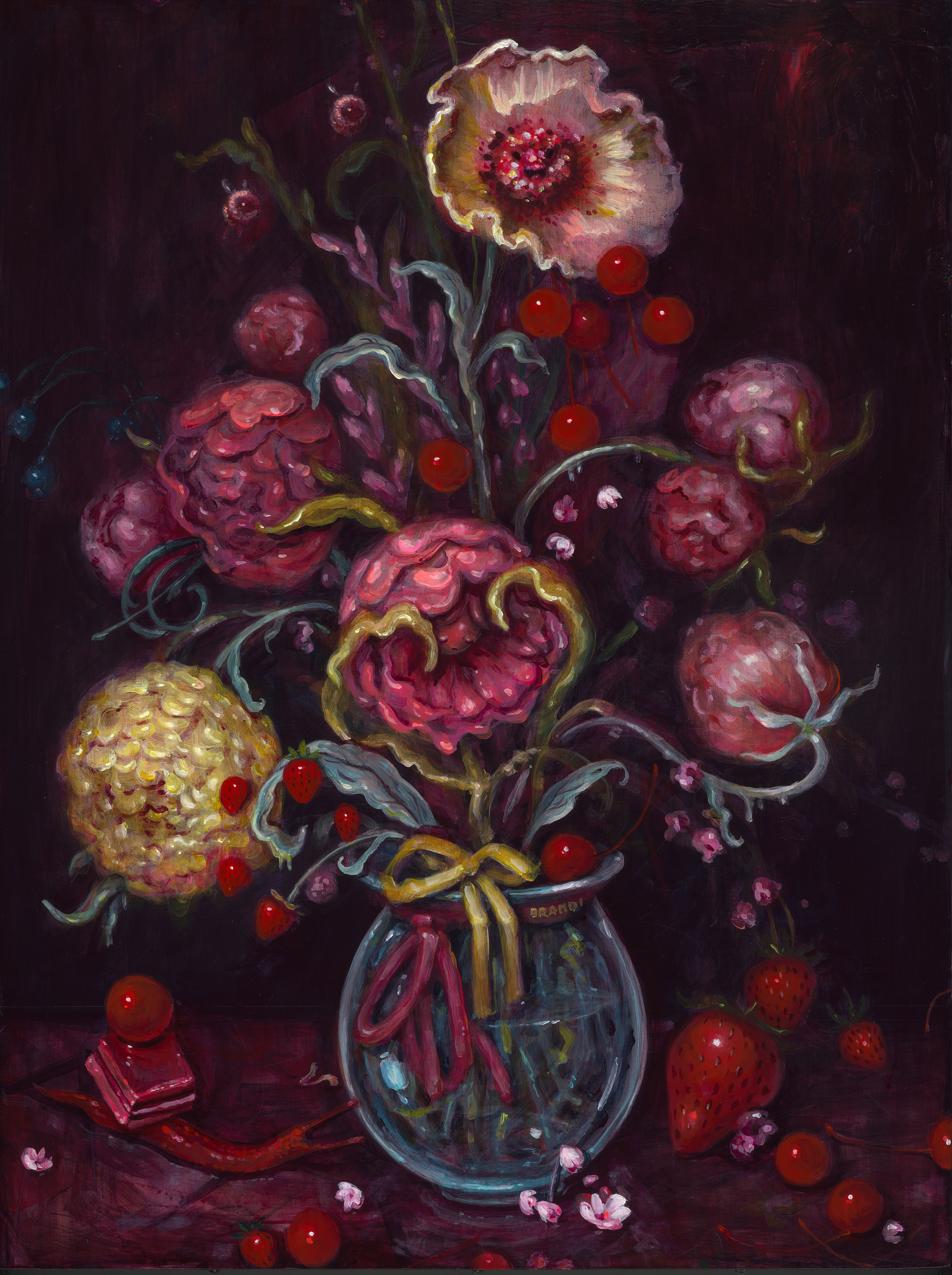
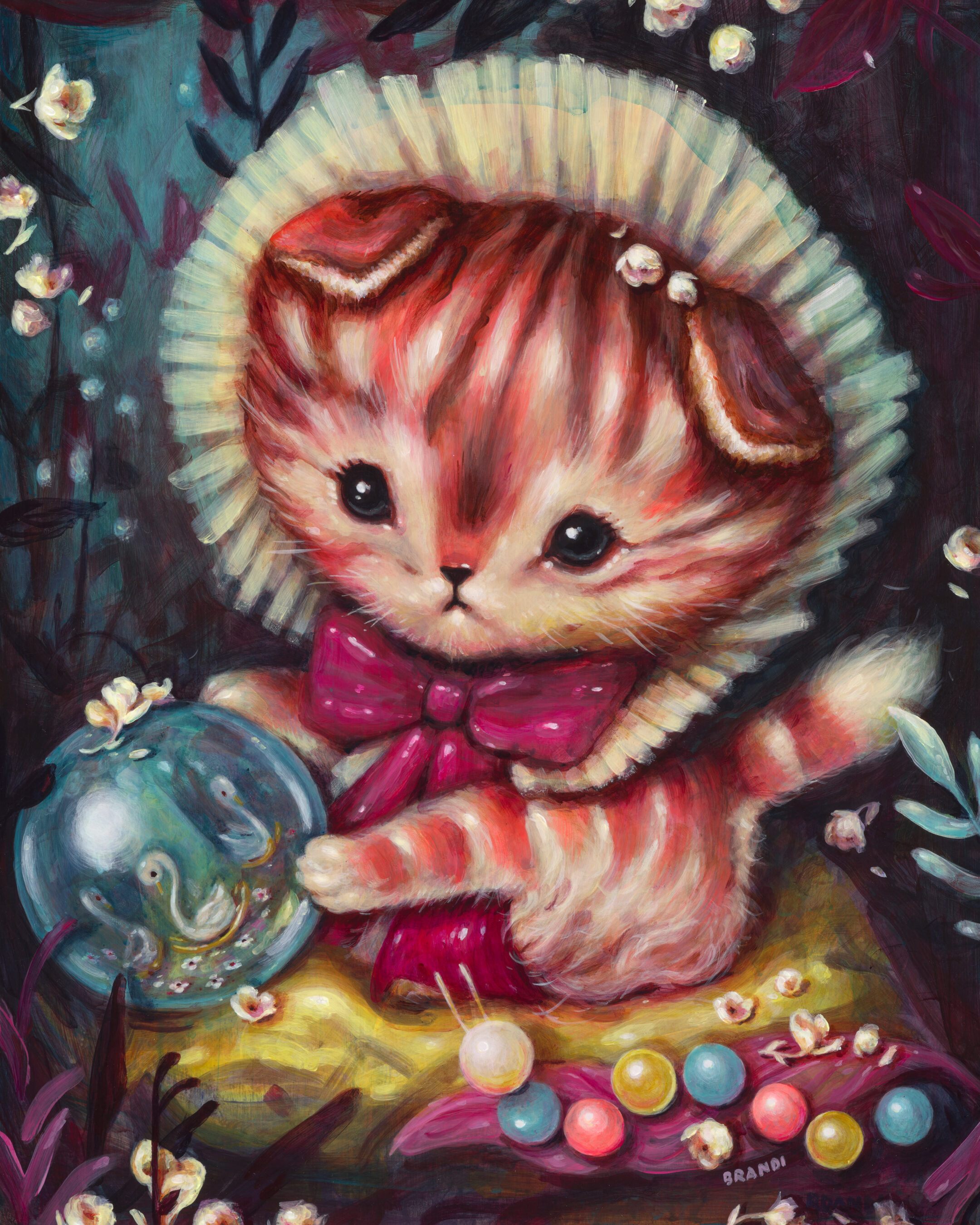
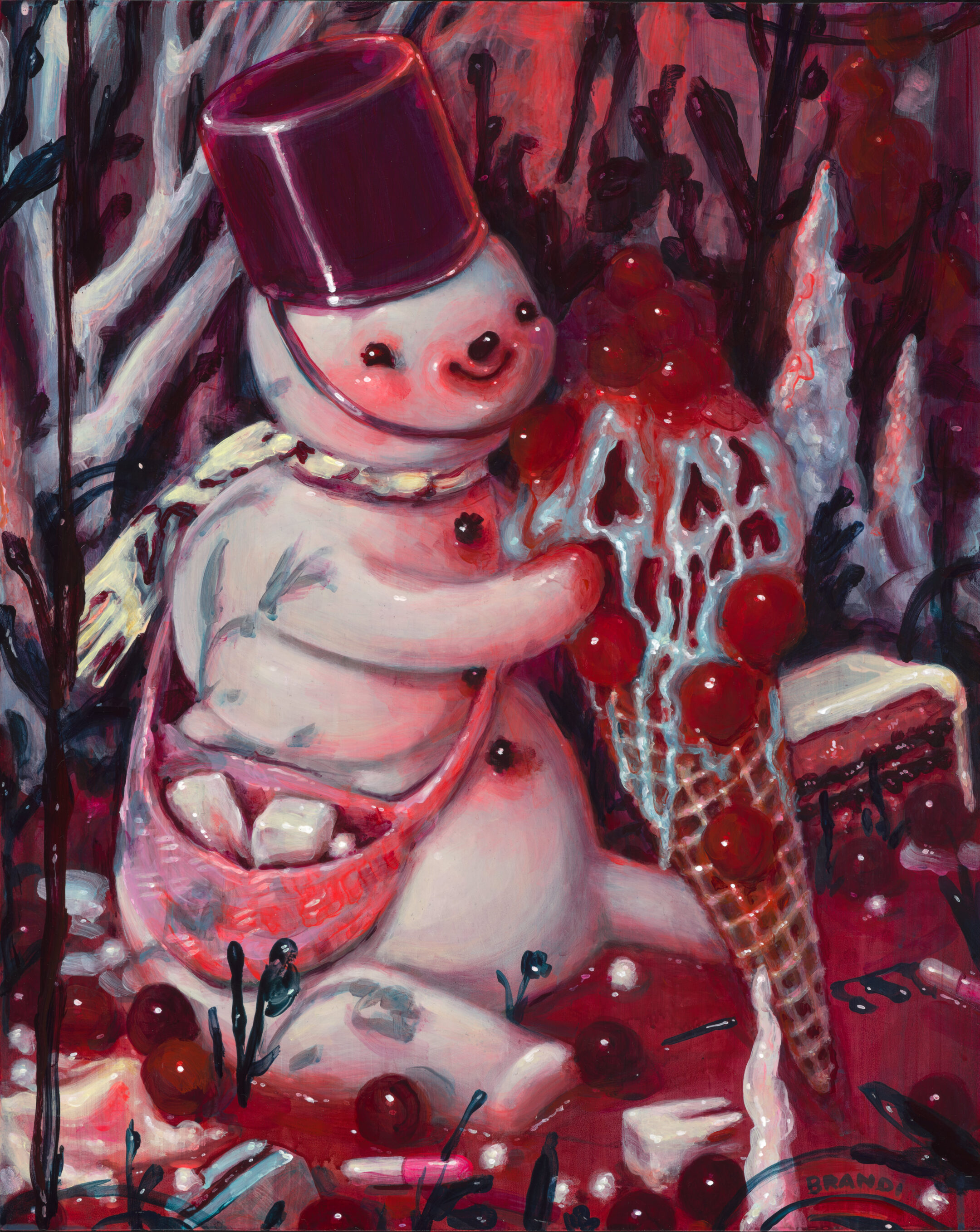
At first glance, stepping into Brandi Milne’s artistic universe feels a bit like tumbling into a beautifully preserved, candy-colored dreamscape. Populated by wide-eyed characters, innocent kittens, and a distinct nod to vintage children’s book illustrations, her paintings instantly wrap you in a warm blanket of childhood nostalgia. But if you linger in front of her canvases for more than a quick second, you’ll realize that these soft reveries are actually holding up some of the heaviest pieces of the human experience.

Sawa: You create such a distinctive world in your paintings. I know a lot of your work stems from grief and trauma, but how do these worlds also serve as a place of joy and comfort for you?

Brandi Milne: It is all the stuff — all the alchemy of pain and grief, all of it. But while I was little, growing up, I didn’t necessarily have a support in my voice. I didn’t know I even had a voice. My upbringing was very religious and controlled. And so for me, art was the place to escape.

As a little kid, I was coloring a lot. And that was where I could go to just be alone. Creativity is like a healing energy. Then as I grew older, and I desperately wanted to be an artist, but I didn’t know that there was art out there to be shown or celebrated or supported.

I was very naive. I had this serious wish, but I didn’t necessarily believe it could come true. In the back of my mind, I just knew I would’ve loved to do this. So then I started to just draw my own characters and explore these places that I was creating that gave me comfort.

Things were very soft and they look very innocent, but there’s a lot more going on under the surface. The visual is something that makes me happy, it brings me joy and it brings me peace. I didn’t know I was creating a world until it was ten years into it. Then I admitted to myself that I’ve created this world, and it’s ongoing, and it is only mine.

Sometimes what comes up in our conversations with artists, is they just paint what comes into their head and it doesn’t necessarily mean anything. And then ten years later they’re like, “Oh shit. I was working through that.”

As we grow and become more in tune with our depths, and when we go through challenges, obviously it peels away some of that naivety or ignorance of ourselves. Challenges give us the real opportunity to know ourselves. And that’s a lovely thing. Art is so crazy in that way. We don’t know ourselves very well and we could be definitely spilling out and not even know it until you look back and you know yourself better. You could really see it like a diary.

Yeah, like the timeline of it all. It is so cool to look back and see the progression of people’s work.

I’m no longer who I used to be. And I’m growing into somebody I don’t know yet.

You’ve also mentioned reaching for light in the darkness? I don’t know if that’s related, but is this an exciting new chapter of your life?

It is. Yeah. I’ve been going through a lot in the last few years. A lot of us have.

Yeah. collectively.

Yeah, yeah. And so because of that, I know myself better today because of it. I care for myself a lot more than I ever used to. And in that, that kind of ego thing falls away, and what emerges is more true to who you are. Like, who I am, my spirit.

And in that way, I don’t know what’s ahead. I’m open in a way that I haven’t been before. The opportunity for self-exploration. To recognize a lot of stuff that has fallen away. And I’m excited to move in the world in a different way.

I love that for you and for all of us.

All of us.

“I’m no longer who I used to be. And I’m growing into somebody I don’t know yet.”

You’re acutely self-aware, which comes through in your work, which is very personal. And you’ve mentioned that a lot of your paintings have become a kind of self-portrait in a way. I would think to make work that meant something, it would have to be personal. It is always a way of expressing a feeling or a part of your consciousness.

Yeah, it is in my process, the way that I sit down to draw something or paint something or flesh out an idea. I first of all think about what character I want to build around. So if it’s a Pinocchio, if it’s a skeleton, if it’s a ghost, whatever. And then I sit and ask myself, “What am I feeling? What kind of emotion can I project onto this character?” And then I build around that. So if it’s a ghost, and I’m going through a lot of challenges in life within my family or whatever, instead of being all messy out there within the situation, I bring it into the work.

And so I ask myself, “What do I want to project onto that?” And then the world fleshes out, in real time before my eyes. Ideas will come to support that, or make it a little more sorrowful or joyful, whatever the emotion is, and it just builds. It builds in front of me and then it reveals me. I’m revealing it, but then it’s revealing me.

There is a very special energy exchange that comes with creating artwork. Everyone uses different mediums, but there’s always that exchange in the act of releasing it. Everyone’s going to have their own interpretation. You said a lot of people in the show had really heartfelt experiences. Did they interpret it in a way that you expected?

I don’t know why I never expect people to feel, you know. And if they do, I don’t expect them to say that. So what I was finding at the opening, people coming up to me feeling and feeling, not just saying like, “Oh my gosh, congratulations. This is a great show.” You know, which is great.

But you could see it in their eyes. They were thinking and feeling and trying to match what they’re seeing and what they’re feeling and asking me, “What are you doing here? What did you do?” And in a really lovely way. What a great energy exchange to have.

The moment that I turn it over to the world, people look at it and then come back to me with their goosebumps or their personal stories that they projected onto it. Which is exactly the point.

It’s so good. It’s so communal. It’s so connecting. In a real way.

Is it a cathartic experience? Do you feel cleansed after you complete a painting or a body of work?

I do, when I’m working on a big body of work. I don’t necessarily feel the cleanse until after the show, because there’s always the next one and the next one and the next one. I could feel myself the weeks ahead of the show opening, I could feel almost like I’m holding my breath to relax, you know, like I couldn’t relax until it was done.

Then I get to the point where I can exhale, where I really feel and process the emotions that (I hate this expression) I just birthed a thing into the world and now I get to breathe.

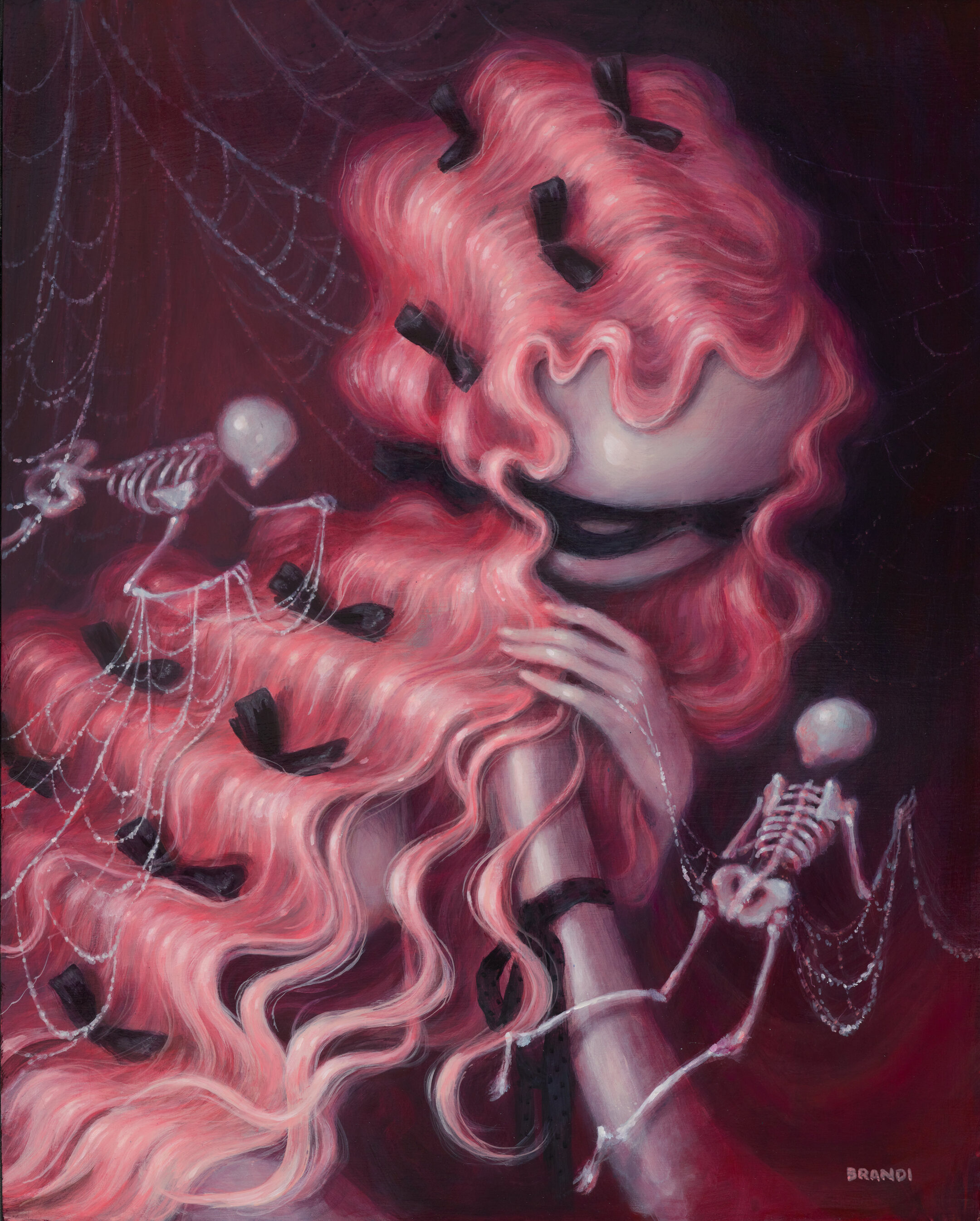
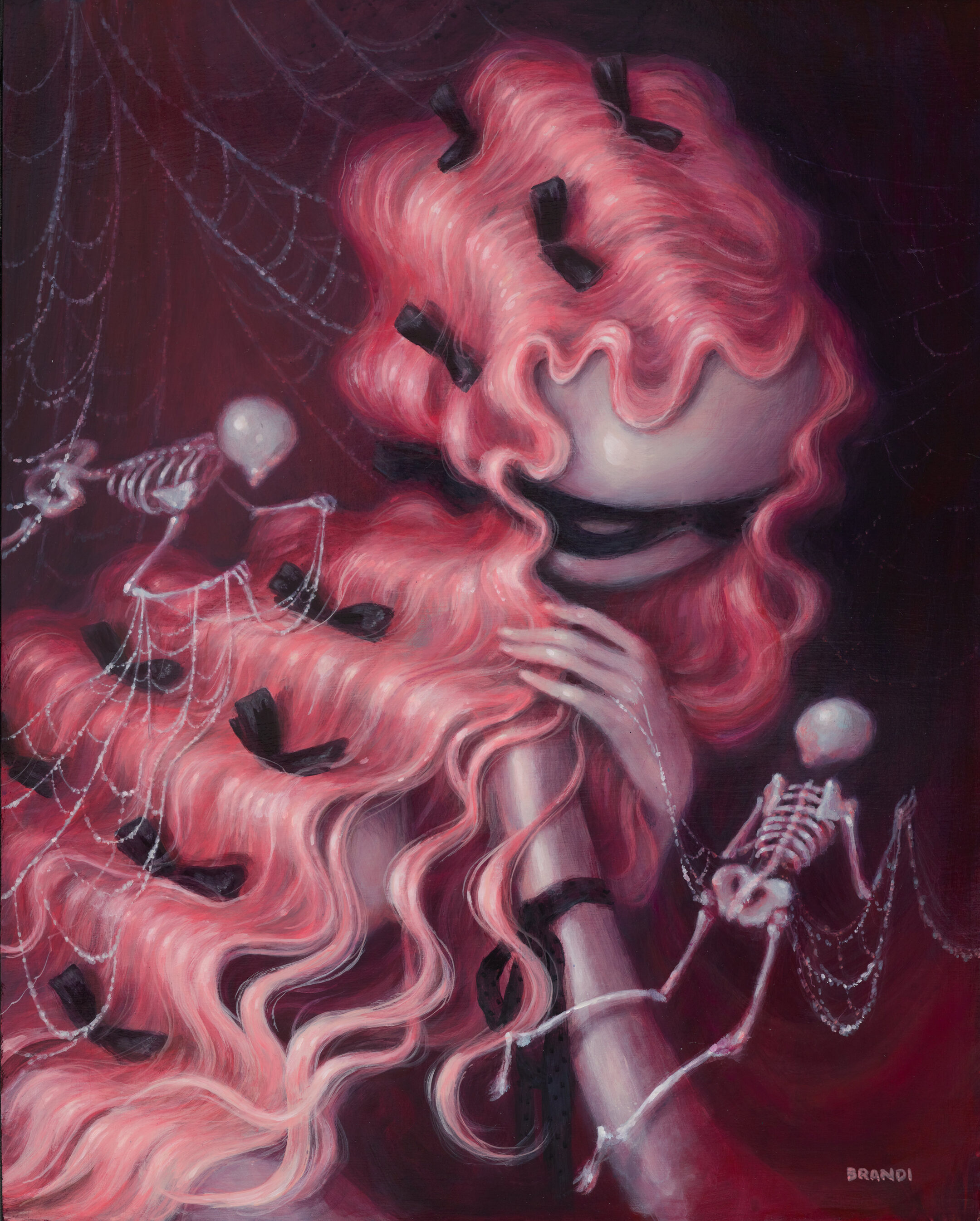
And this show had a lot of pieces that were darker. I was working out a lot of really deep things. And one of the paintings is called Ghost, the big green one, the big girl in the pink room.

Is that the one surrounded by spiders?

Yeah.

Yeah, I was going to ask because I’ve seen them before in your earlier work, the spiders. So I don’t know if there’s something to that.

So Ghost was a part of me that felt like she didn’t have a voice, felt like she didn’t deserve happiness. And she holds a lot of grief. I did that painting for myself, but I ended up putting it in the show.

The piece is about growing up and claiming your strength and your voice and coming out of those dark places. And so the girl is very vulnerable in that painting, with the spiders on either side. It’s like a bookend and they’re protecting her.

I’m creeped out by spiders. I do not even like looking for reference photos for the paintings. I’m like, “Oh my God, I’m torturing myself.” But for some reason, the creepiness of the spiders, it’s almost like going towards your fear. And if I can go towards my fear in this way and have that be the strength, or the protecting on either side of the painting, then that for me gives it a lot more depth for me.

It’s funny because my husband, he saw them on either side and he’s like, “It’s almost like they’re crawling all over her.”

Oh my gosh, I love that.

There’s these recurring objects from your childhood. And from my perspective, sometimes there’s a part of our child self that’s gone now, that we need to mourn or grieve.

I love being a little kid. I felt like I had a really charmed childhood. I didn’t know about the trauma until later, but I really loved being a little kid. And when I was growing up, me and my sister always said , “Oh my gosh, I’m so old.”

We would just grieve having to make these steps to grow older, and I loved all my toys. I still have toys. I have toys everywhere. Like, everywhere. But I was grieving, I was grieving to leave those things.

The grief of leaving that childhood warmth and nostalgia… A lot of people don’t like nostalgia, which was a shock to me because I love it. But for me, I use it as a language, as a connecting tool, because we were all little kids, whether or not we had similar upbringings. But to bring that childlike innocence into the work is how I invite everybody in and tell them that they’re entering a safe, warm place. There’s lots of dark stuff going on in our world, but everybody can come here and be safe. Everybody can come here and feel their feelings, and it doesn’t have to turn ugly or turn inward against yourself.

I like that, a safe place. Also, kids just love to draw and create and make. And as we get older we’re told that having any sort of creative practice is not realistic, so a lot of people leave that behind. But I think that’s another part of our childhood that should carry over. I know you were self-taught, so when did you get started in art?

How did I get serious?

Yeah. And how did you teach yourself?

I think all of it was teaching, right? The coloring books, the style of coloring books that I wanted to color in, the ones that I preferred had darker lines, big, bold lines. A huge muse for me now is children’s books and their illustrations. This stuff informed my world that I did eventually get to create. But I think throughout high school I was always drawing, I was always doodling. I just drew. This was in the 90s.

My boyfriend, now husband, loves my work. He was the biggest supporter that I had up to the point I got serious. He pushed me to really take this seriously. And then he found Cannibal Flower, which was in the early 2000s. And when I heard that… dude I, I can feel it right now. It was one of those moments. Growing up, I wanted so badly to be an artist. And then the universe just came down and handed me this number and said go here, and show your work.

On a good day when you’re in your practice, what would your daily routine be?

On a perfect day, which I haven’t had yet.

A perfect day. I would love to get up early, work out, and then go to the beach and just hang out with the ocean for a minute, and then come back, have a cup of tea and then get into my studio. I love to have time to write before I work. I love to have space, to be a human and feel and think and breathe before I ask myself to then get to work.

So if I can do that, I probably would get to work at about 11:00 AM and then work for about six hours on a perfect day. And to get into music while I’m working. Music is one of my biggest muses, you know.

Same.

It moves you. It moves the things that are happening.

In what way is this current series your most vulnerable work to date?

That’s a good question. I think the humanity, for me — it was really hard to find words to put in the press. It’s hard to put into words what is so complicated, and with the darkness and the light and all that stuff. So for me, I guess I would say that what I offered in this show to the world, if you will, is just humanity and connection.

I would want people to see themselves in that, if the piece is vulnerable and it’s talking about our grief, I want people to see that and connect with that within themselves.

Based on that, your painting of the kittens eating the piece of meat, what is that about?

The meat represents the rawness of life.

And just devouring it.

Right. An older painting from my last show, which was in 2022 at Corey Helford Gallery, was a bunch of kittens drinking a bowl of blood. And those two paintings play off each other, and it’s about the running of life. It’s about being poisoned. It’s about death, and also anonymity.

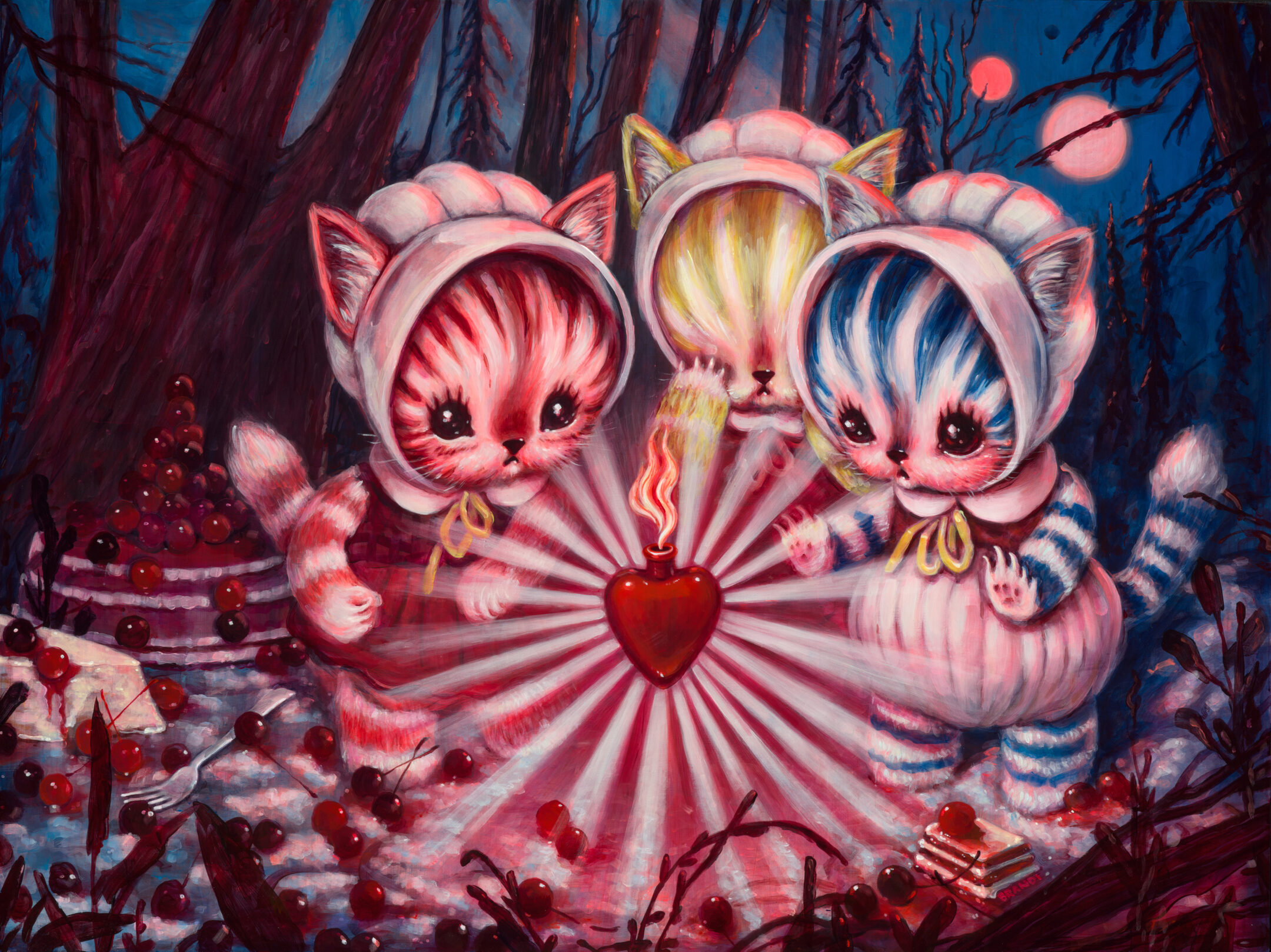
What about the kittens with the sacred heart?

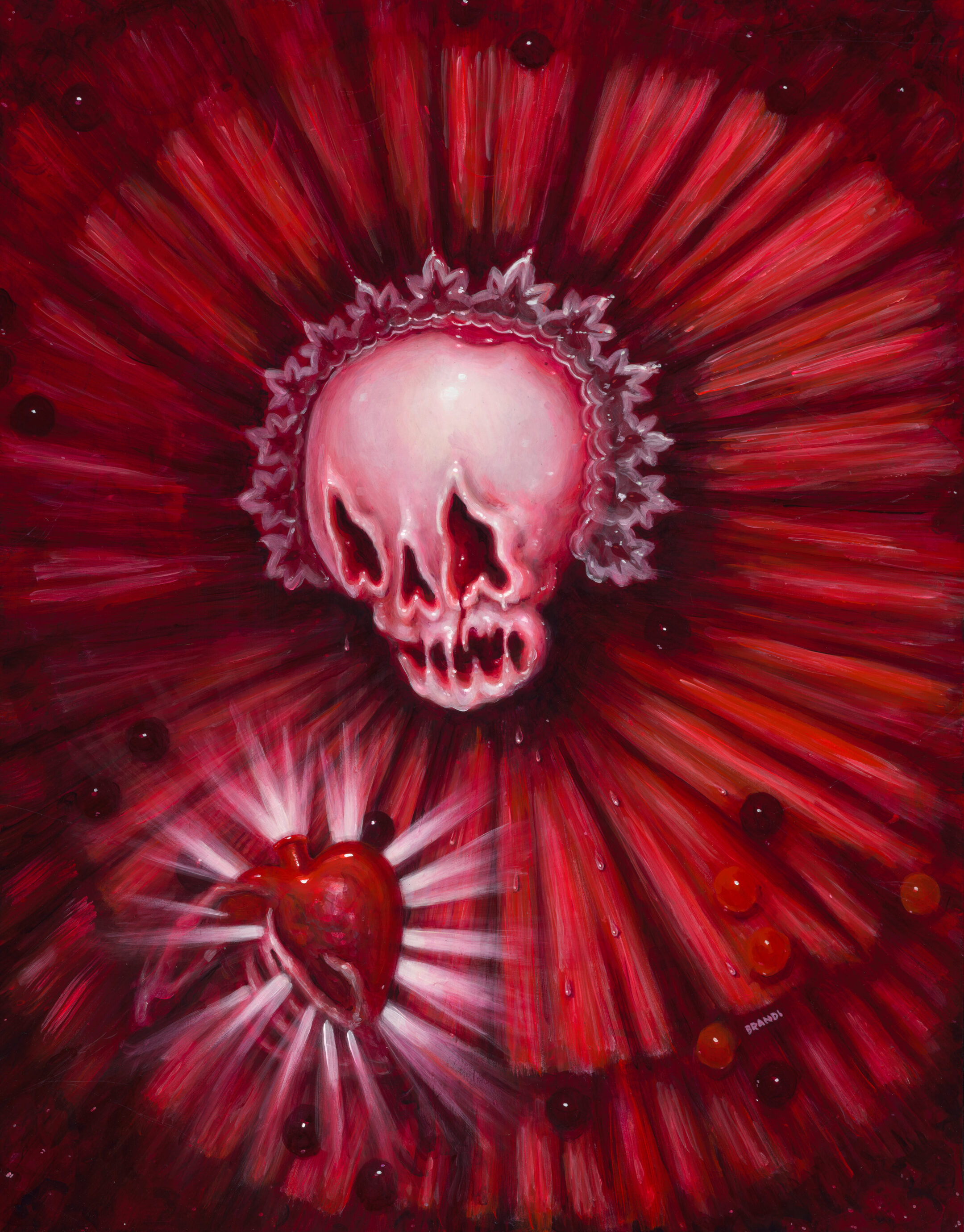
That painting is the moment that we see the beauty of ourselves. That is the moment that we see our humanity and the value of our love, of our light, the things that could bring us to tears if we’re really connected to it.

It’s honestly just within our humanity. Here is our humanity, and these are our capabilities. And that’s a beautiful gift, even though it’s hard.

But it is a truly beautiful gift.

Share

You might also like ...

Get Art Bar news in your Inbox

Follow us
Yearly Subs Save 20%

Delivered quarterly.