Dark Art – Mothmeister
- Curation and interview by Diana M. Ahuixa
- Published:
- In Dark Art Feature
Healing the Jungian shadow-self through dark art.
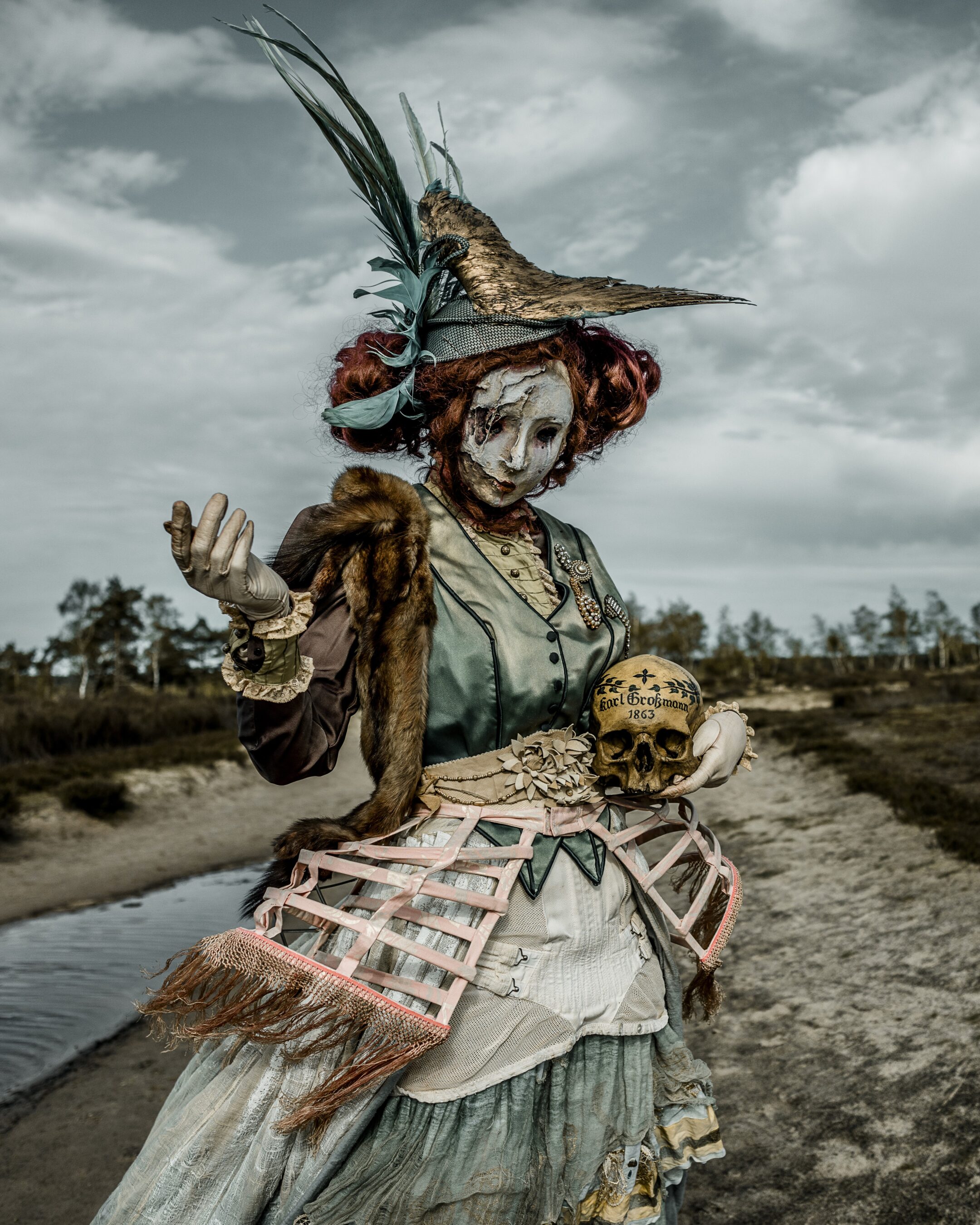
How do you build and maintain this consistent universe across different images and projects?
Each of our characters may whisper in a different tongue, but they are all blood of the same brood — the Mothmeister family. What binds them together is not just their grotesque beauty, but the way they exist within a world of decay and devotion. Our universe breathes through three veins: the behaviour of our veiled beings, the desolate backdrops they haunt, and the loyal, lifeless animals they cradle as if they were kin.
We scour forgotten places for the right setting. Wounds in the earth. Lonesome coastlines. Ashen woods and skeletal ruins. Nothing in our backgrounds is static — even silence speaks. A burned tree, a hint of amethyst mist, a bone-coloured expanse — these aren’t just scenes, they are sentient. They shape the narrative like a ghost shapes the temperature of a room.
Our characters never scream; their violence is inward. Their masks may disturb, but the figures beneath are tender, broken, sacred. Always shielding their dead — their creatures — with a reverence that denies death itself. The animal is not a prop; it’s a relic. A totem. A soul preserved. The love doesn’t rot. It lingers. Festers. It transforms into ritual.
And the sky… the sky must weep or rage. It must ache with meaning. Blank blue is a betrayal. It tells no tale. It is the silence after the last scream. We crave skies with teeth — bruised, bled, scorched — skies that mirror the grief stitched into our world.
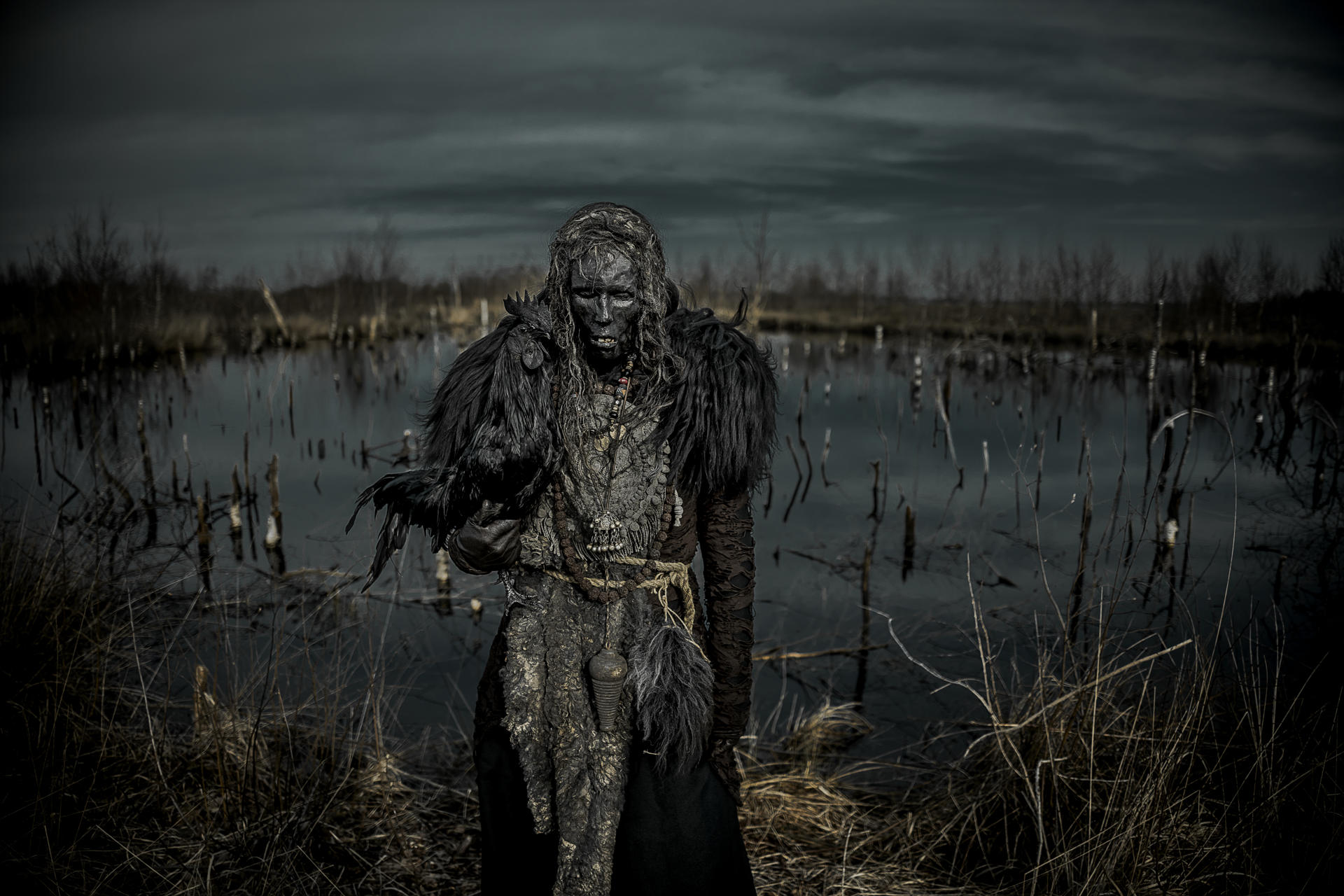
Do you find connection to the characters you create?
Yes, we connect deeply with our characters. We don’t just create them — we inhabit them. We breathe through them, and sometimes, they breathe through us. This is what our ideal world looks like: strange, sacred, sealed off from the noise of the ordinary.
Once the mask is on, the senses begin to vanish. You can’t see clearly. You can’t smell or hear. Breathing becomes shallow — ritualistic. The outside world fades. All that’s left is the being beneath the skin. You’re no longer pretending. You are the character. You’re locked in — fully immersed. Trapped in another self. And there’s a strange kind of freedom in that.
Since emerging in 2014, how do you feel your work has evolved over time? What are some of the most significant changes in your style or process?
Our world has undeniably grown darker — and deeper. More visceral. The title of our first book, Weird and Wonderful Post-Mortem Fairy Tales, captured the early spirit: eerie, strange, a bit circus-like in its surrealism. But as the years passed, our characters began to mutate. They shed their playful skins and became more solemn, more haunted. The grotesque matured. Shadows grew teeth.
That evolution birthed our second book, Dark and Dystopian Post-Mortem Fairy Tales, where the shift became undeniable. We delved further into religious iconography, drawn to its symbolism, its ritualistic beauty and inherent discomfort. Our journeys took us to decaying ruins — places heavy with silence and stories left behind: Chernobyl’s ghost towns, the flooded bones of Epecuén, the suffocating beauty of catacombs. These landscapes bled into our universe.
Our most recent work, Sinister and Spiritual Post-Mortem Fairy Tales, is perhaps our most macabre. We drew from death-obsessed cultures: bog bodies preserved in peat, druidic rites, voodoo ceremonies, the self-mummified Sokushinbutsu monks, and the cannibalistic Asmat tribe. All of them gave us a sacred kind of horror — where faith, death, and transformation become indistinguishable.
Yet despite the evolution in tone, our process remains untouched. We still surrender to instinct. It’s ritualistic: We silence the thinking mind, let it go dormant. Then we wait… until it erupts. Like a sleeping volcano finally breaking its stillness. What flows out is raw, unfiltered — the truth of that moment, without censorship or hesitation
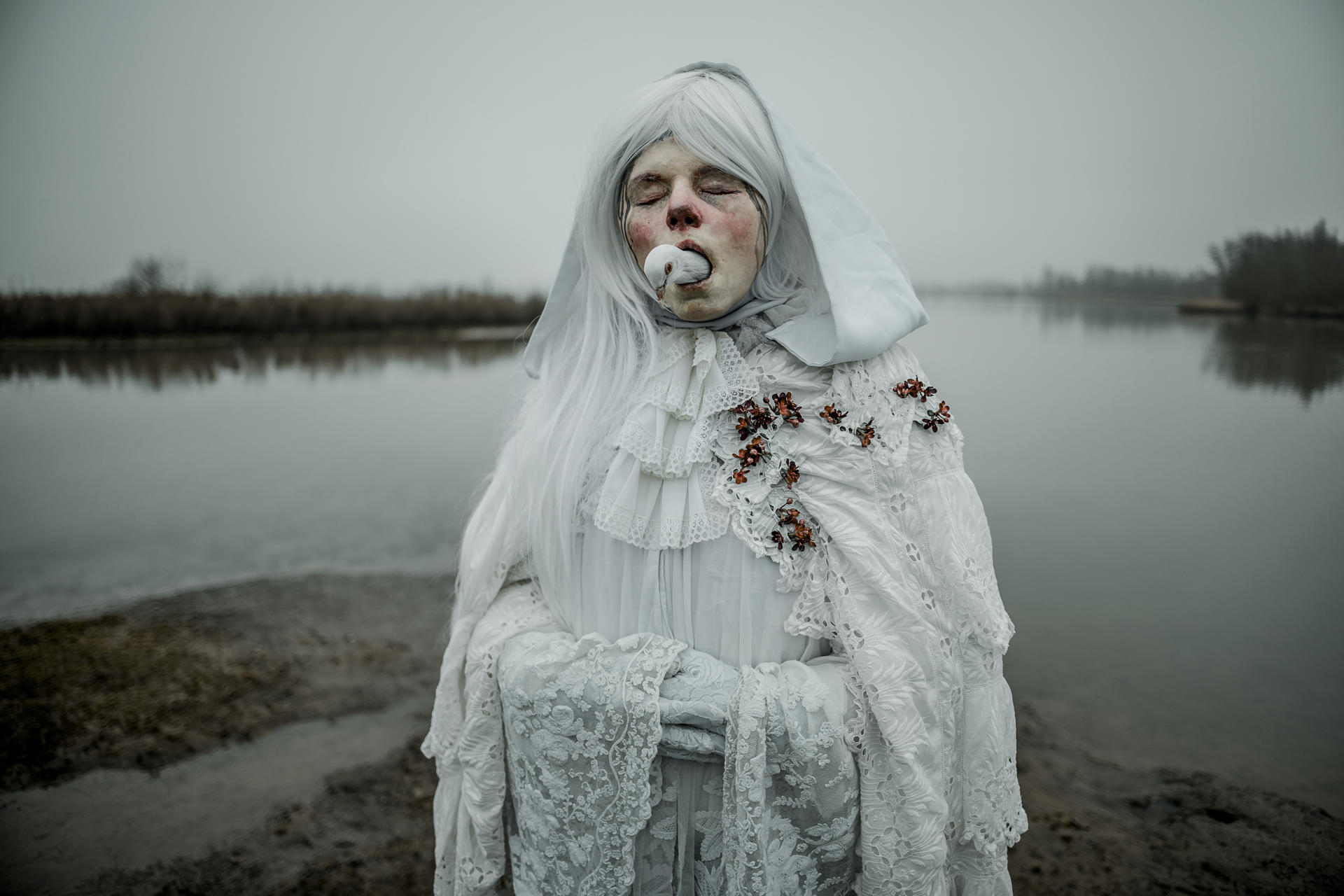
You incorporate a lot of religious iconography despite being atheists. What makes religion and its imagery an interesting universe to explore in your work?
We’ve been atheists from the very beginning — and remain so without doubt. But atheism doesn’t mean indifference. Quite the opposite. Religion, to us, is one of the most fascinating human inventions — a theatre of belief, ritual, control, ecstasy, and fear. The concept of surrendering to a higher power, of building entire lives around unseen forces… it’s both beautiful and terrifying. It transcends the individual. It bleeds into culture, architecture, costume, myth. It becomes legacy. That kind of devotion is something we can’t ignore.
Religious iconography is a deep well of symbolism. It’s visual poetry. Statues weep. Saints bleed. Bodies contort in ecstasy or agony. The pageantry, the relics, the robes — all of it speaks to a yearning for transcendence. And that yearning is something our characters understand. Even in their grotesquery, they long for something beyond themselves.
We draw from all corners: Catholicism’s golden rot, the raw physicality of the Aghori, tribal rites where gods live in bones and masks. Each tradition offers its own strange magic. Its own weight. And when we flirt with those elements — not to mock, but to reframe — it elevates our figures. It gives them myth. It gives them purpose.
Religion, for us, isn’t about belief. It’s about atmosphere. Power. Fragility. It’s a lens through which humanity exposes its most intimate fears and desires. And that’s exactly where our work lives.

Since Obrazrat is being interviewed as well, how did your collaborations come about with her?
We stumbled upon her work on Instagram, and it was an instant coup de cœur. A visceral reaction. Her masks weren’t just objects — they felt like relics from another realm. There was something raw and otherworldly about them. The shapes, the scars, the brittle textures, the ghosted colors… they spoke to us in a language we didn’t know we understood. So we reached out.
Obrazrat didn’t hesitate for a second. That immediate “yes” was the beginning of a beautiful creative collision. Working with her opened doors we didn’t know existed. Her masks summoned characters that had been waiting in the shadows, unformed and unnamed. She gave them their first breath.
Since then, we’ve collaborated several times — though we’ve never met in person. But it doesn’t matter. There’s a rare kind of creative chemistry that doesn’t require words. It’s instinctual. A silent understanding. Her work plants a seed, and we grow the world around it. Her masks find their place — effortlessly — in our universe, like they were always meant to be there.
And beyond the work itself, she’s simply a beautiful soul. That matters. We’re allergic to ego. Too many artists are more in love with themselves than with what they create. But Obrazrat is the opposite — generous, grounded, and genuine. Creating with her is not just a collaboration. It’s a resonance.
What is a common misconception you’ve encountered about your work that you would like to address?
In this era dominated by the cold advance of artificial intelligence and synthetic creativity, many assume our work is nothing more than digital trickery — some illusion crafted by machines. They think we fade into the background, mere pixels merged with fabricated scenes and characters. But that couldn’t be further from the truth. What you see are flesh and blood people, gripping real animals, standing in raw, unforgiving environments.
Sure, it would be easier to build our worlds entirely in a digital realm — no heavy bags to haul, no taxidermy creatures to carry over rough terrain, no grueling hours spent chasing that elusive perfect moment in some godforsaken wilderness. But for us, authenticity isn’t a convenience. It’s a brutal necessity. The soul of the work demands it. No matter the exhaustion, no matter the pain or the distance, it’s a sacred ritual we endure, because anything less would be a lie.


Share
You might also like ...

Dark Art – Ariel de la Vega
Your drawings are noted for their use of a white line on a black surface. What is the significance of this inversion of traditional drawing,

Dark Art – The Lijilja
Your work is deeply personal. How did this style of performance develop for you? Were there mentors who shaped it? How did your mode of

Dark Art – Sven Harambasic
In an interview, you mentioned that you prefer to deal with “isolated, inner worlds” rather than wider social commentary. How do you find and explore

Dark Art – Samuel Araya
The dark art genre sometimes exists outside of the mainstream art world. Has the intense and provocative nature of your work created any unique challenges

