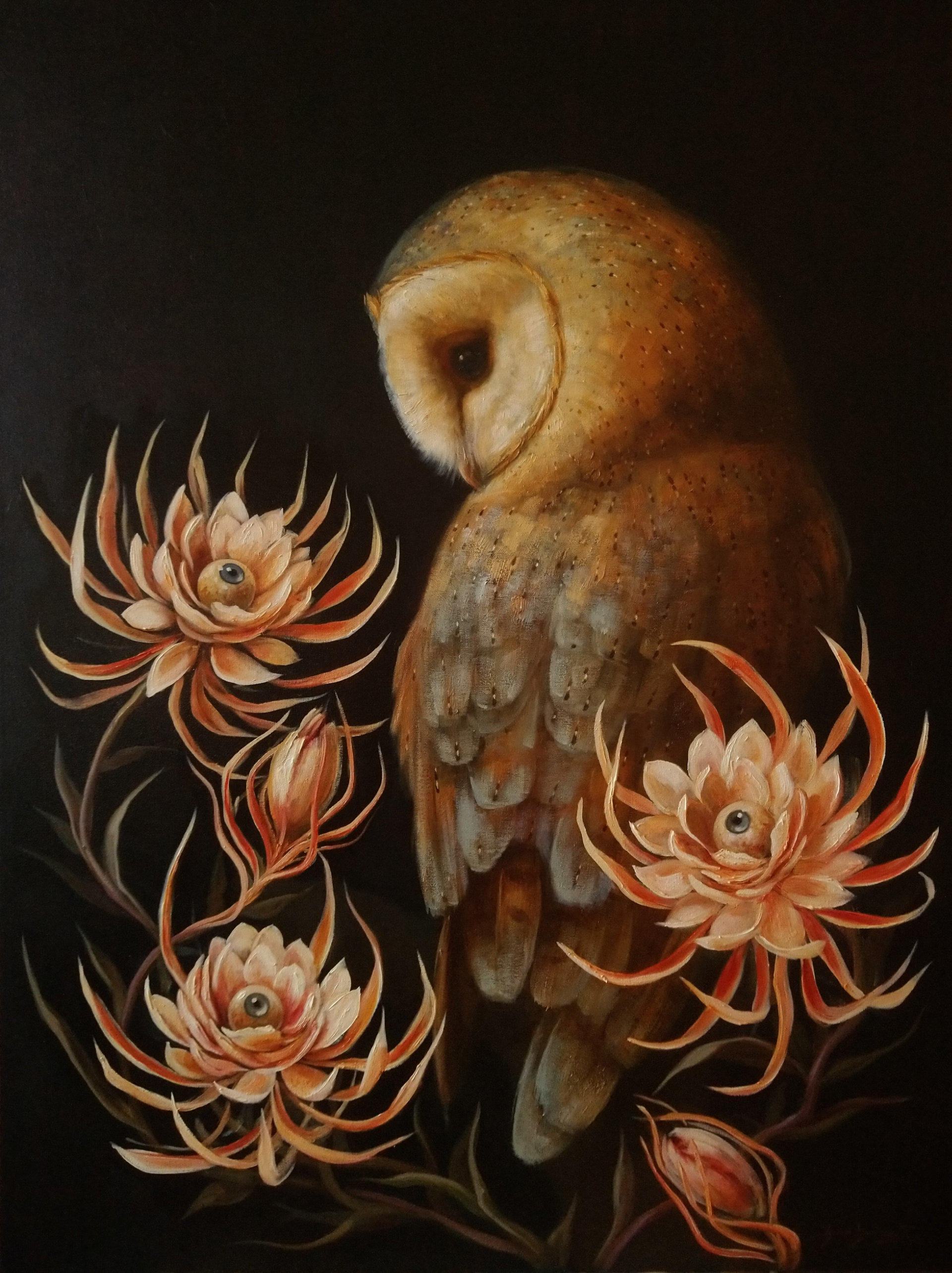
Your art has a distinct aesthetic that often blends mythology with dark, surreal elements. What is your conceptual process for creating these figures and scenes? What story do they tell?
My work’s main interest lies in concepts like time, death, and eroticism. The pieces don’t tell a particular story; they are metaphors and allegories that aim to find an ambivalent meaning within each painting. For example, on one hand, they address the fleetingness and banality of existence, but at the same time, the knowledge and certainty of death as an important part of life. I construct these images using mythical and religious references.
Which artists or artworks have most influenced your style?
Francisco de Goya’s Black Paintings and his witchcraft series have greatly influenced my work. I also feel deeply influenced by the general work of Francis Bacon. Caravaggio and Rembrandt are constant references for my painting and palette.
What is your perspective on the role of beauty within the grotesque?
Well, I suppose there can be art within what isn’t beautiful, but it’s more difficult to find beauty as such within the grotesque, and yet, it can be there.
For example, in bullfighting, or the fiesta brava<s, the mistreatment of the bull is reprehensible, as is the splattered blood and the gasping of the exhausted animal that will soon be sacrificed for mere spectacle. And yet, bullfighting has been a source of inspiration for many artistic disciplines, whether for or against. Lorca’s poem “Lament for Ignacio Sánchez Mejías” even talks about a bullfighter (his friend) bleeding out, which is a grotesque event but is ultimately transformed into art.
However, I think it’s important to mention that it’s one thing to find and look at the grotesque under artistic and aesthetic parameters, and another to be able to say, because of this act of sublimation, that there is an intrinsic beauty.