Dark Art – Django Nokes
- Curation and interview by Diana M. Ahuixa
- Published:
- In Dark Art Feature
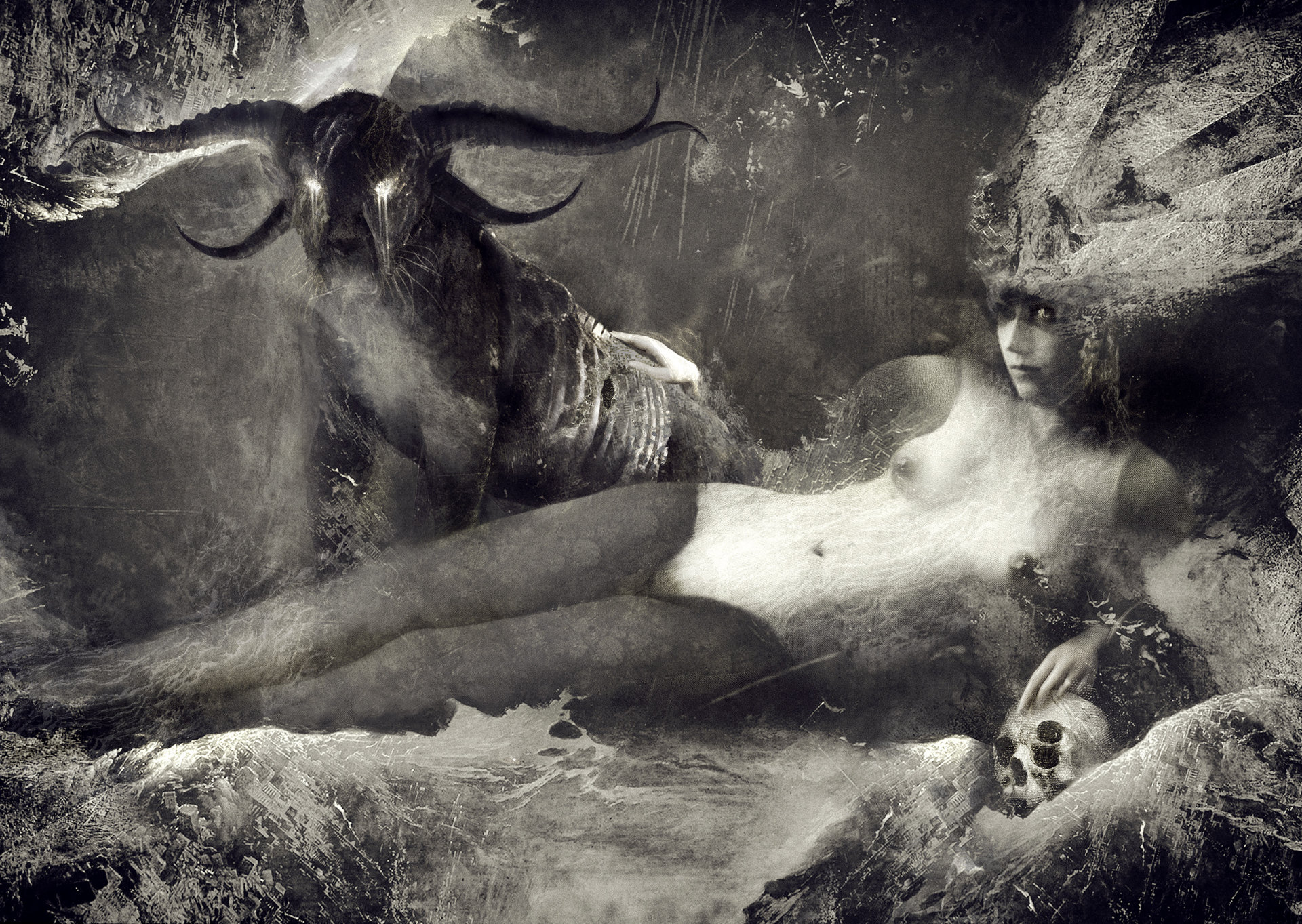
You’ve mentioned being heavily influenced by music and horror films. How do you feel these media, particularly metal and psychological thrillers, have shaped your artistic voice and the narratives you create?
Since I was a child — whether by fortune or misfortune — I grew up in a very open-minded family (ex-hippies), so certain barriers were simply never there. My parents, being passionate about cinema and music, really opened the way for me. I still remember being 11 or 12 and watching Suspiria by Dario Argento on TV with my mother — that was definitely a kind of blessing. As for music and my personal taste, the extreme metal scene of the ’90s had a huge influence on my work. In many ways, it became, and still remains, the soundtrack of who I’ve become.
You’ve stated that you are trying to be both “provocative and elegant” at the same time. How do you navigate that balance, and what is your philosophy on the relationship between beauty and horror?
For me, beauty and horror are not opposites, they coexist in the same space. I try to be provocative by pushing boundaries, but I balance that with a sense of elegance, so the darkness never feels gratuitous. It’s about creating curiosity: Something unsettling that still draws you in. My philosophy is that true beauty often carries a shadow, and true horror often hides a strange kind of grace. I want my work to live right in that fragile space between the two.
Creatively and commercially, how has the proliferation of AI art impacted your career? How do you protect your style from AI users utilizing your works for their own commercialization?
The rise of AI-generated art has definitely reshaped the creative and commercial landscape. On one hand, it has made people more curious about digital aesthetics, but on the other, it risks diluting the value of originality and personal vision. For me, art is not just about producing an image — it’s about the journey, the obsessions, the imperfections that AI cannot replicate. To protect my style, I focus on making my work unmistakably mine, investing in details, atmosphere, and narrative depth. I also remain vigilant about how my images circulate online, and when possible, I take action against unauthorized use. Ultimately, I believe authenticity and a strong artistic voice are the best shields against being absorbed into the mass production of AI.
In a world where a lot of art relies on established mythologies, how do you find inspiration to create entirely new environments and beings from scratch? Does the darkness you create emerge from a specific narrative you are telling, or is it more of a direct, pure expression of an emotion or mood?
I draw inspiration from memories, dreams, music, and small everyday details. I try to create environments and beings with their own history and logic, without relying on pre-existing mythologies. The darkness in my work sometimes comes from a narrative, other times it’s a direct expression of an emotion or mood, alive and independent within the space of the piece.
What is your philosophy on the artist’s role in guiding or withholding narrative, and how do you feel about the interpretations people create?
I believe an artist’s role is to open a door, not to dictate the path. I provide the atmosphere, the symbols, and the forms, but I intentionally leave space for interpretation. The stories people create from my work are as important as the work itself; they become part of its life. I see the audience’s imagination not as a misreading, but as a collaboration, a way for the piece to grow beyond my original intention.
How does your environment influence your art?
Having grown up both in England and Italy, this has definitely had a strong impact on me. I now live in Tuscany, in a small seaside town, which is very inspiring. I’m fortunate to be surrounded by truly magical places from medieval villages to forests and countryside, all the way to the sea. The contrast between these environments is reflected in my work: One part is gothic and Victorian, while the other is rough and decadent.
What upcoming projects or exhibitions are you currently working on?
At the moment, I have a work exhibited in Italy at the Premio Rotonda in Leghorn, a historic contemporary art showcase that started in the 1950s. I also have pieces exhibited and for sale at the Revolution Gallery in Buffalo. Right now, I’m focusing on new works and creating artwork for bands. We’ll see what the future holds.
The dark art genre tends to exist outside of the mainstream art world. Has the intense and provocative nature of your work created any unique challenges for you in seeking gallery representation?
Working within the dark art genre does present unique challenges. Its intense and provocative nature can make galleries hesitant, especially those more accustomed to traditional or commercial styles. However, I see this as an opportunity rather than a limitation. It pushes me to seek out spaces and collaborators that truly understand and appreciate the vision behind my work.
How do you see the artworld pre and post pandemic?
I’ll try to be brief, because there’s a lot to say about the pandemic, having been in the first European country to be affected. How I see the art world before and after… I’m not sure. During the lockdown, I never imagined people would turn so strongly to online orders. However, this helped me gain much more recognition abroad, mainly in the United States. The pandemic was a disaster in many ways, but like many others, we kept working even in this terrible situation, and it did bring some results.
Share
You might also like ...

Dark Art – Ariel de la Vega
Your drawings are noted for their use of a white line on a black surface. What is the significance of this inversion of traditional drawing,

Dark Art – The Lijilja
Your work is deeply personal. How did this style of performance develop for you? Were there mentors who shaped it? How did your mode of

Dark Art – Sven Harambasic
In an interview, you mentioned that you prefer to deal with “isolated, inner worlds” rather than wider social commentary. How do you find and explore

Dark Art – Samuel Araya
The dark art genre sometimes exists outside of the mainstream art world. Has the intense and provocative nature of your work created any unique challenges


