Dark Art – Emil Melmoth
- Curation and interview by Diana M. Ahuixa
- Published:
- In Dark Art Feature
Your work blends themes like religious immortality and paradise with bodily imperfections and medical anatomy. What motivates this juxtaposition, and what message do you hope it conveys about the human experience?
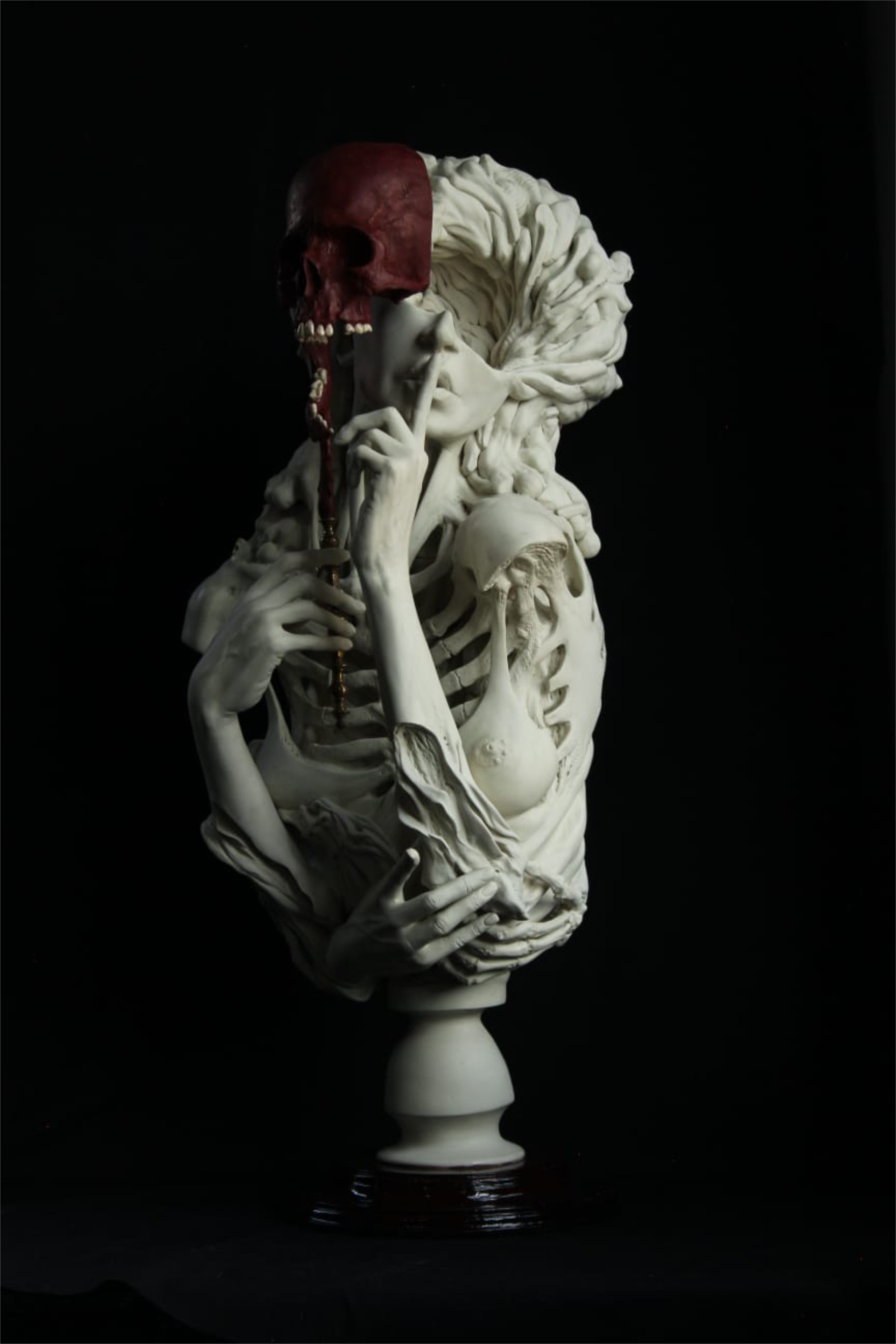
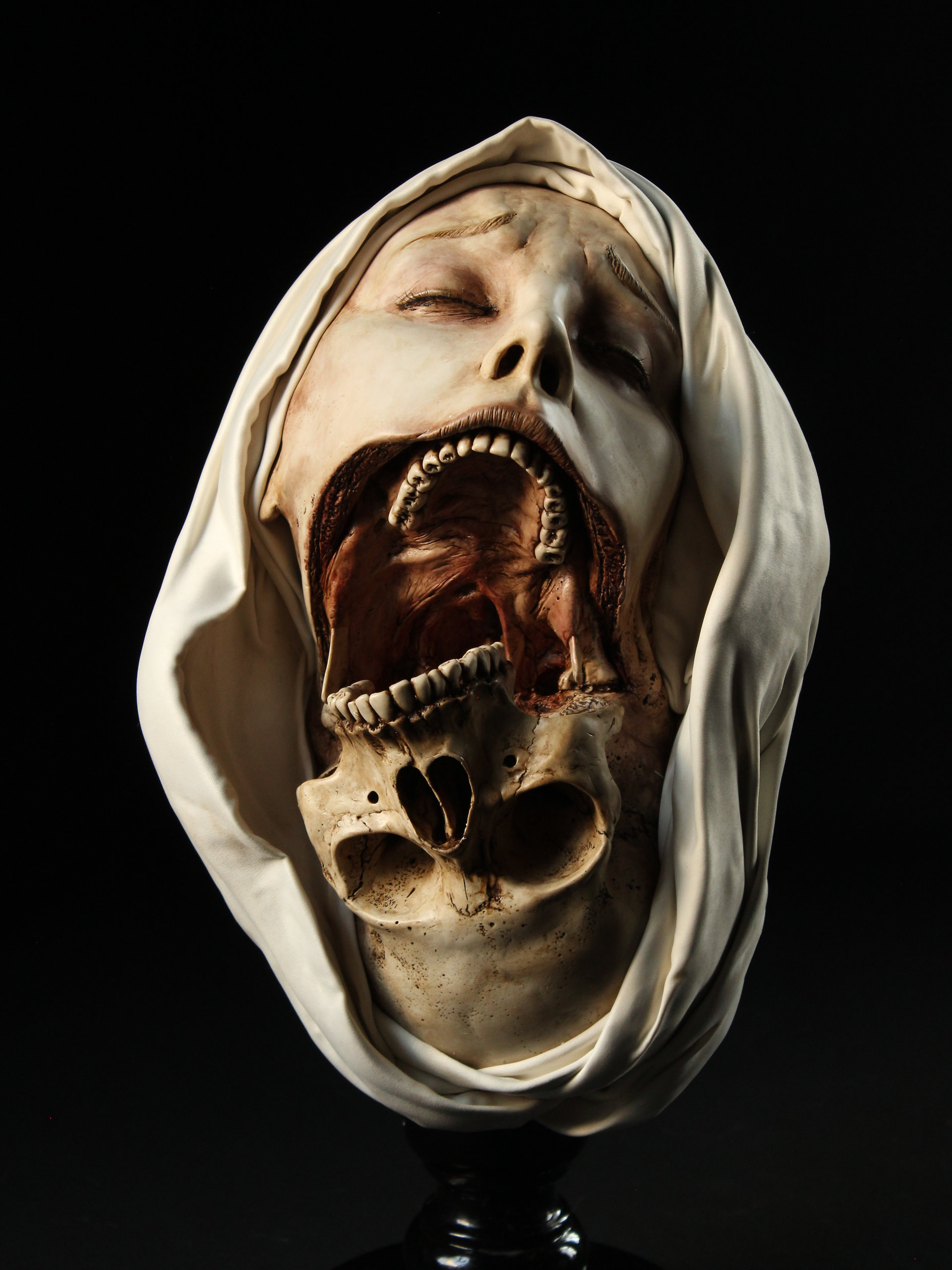
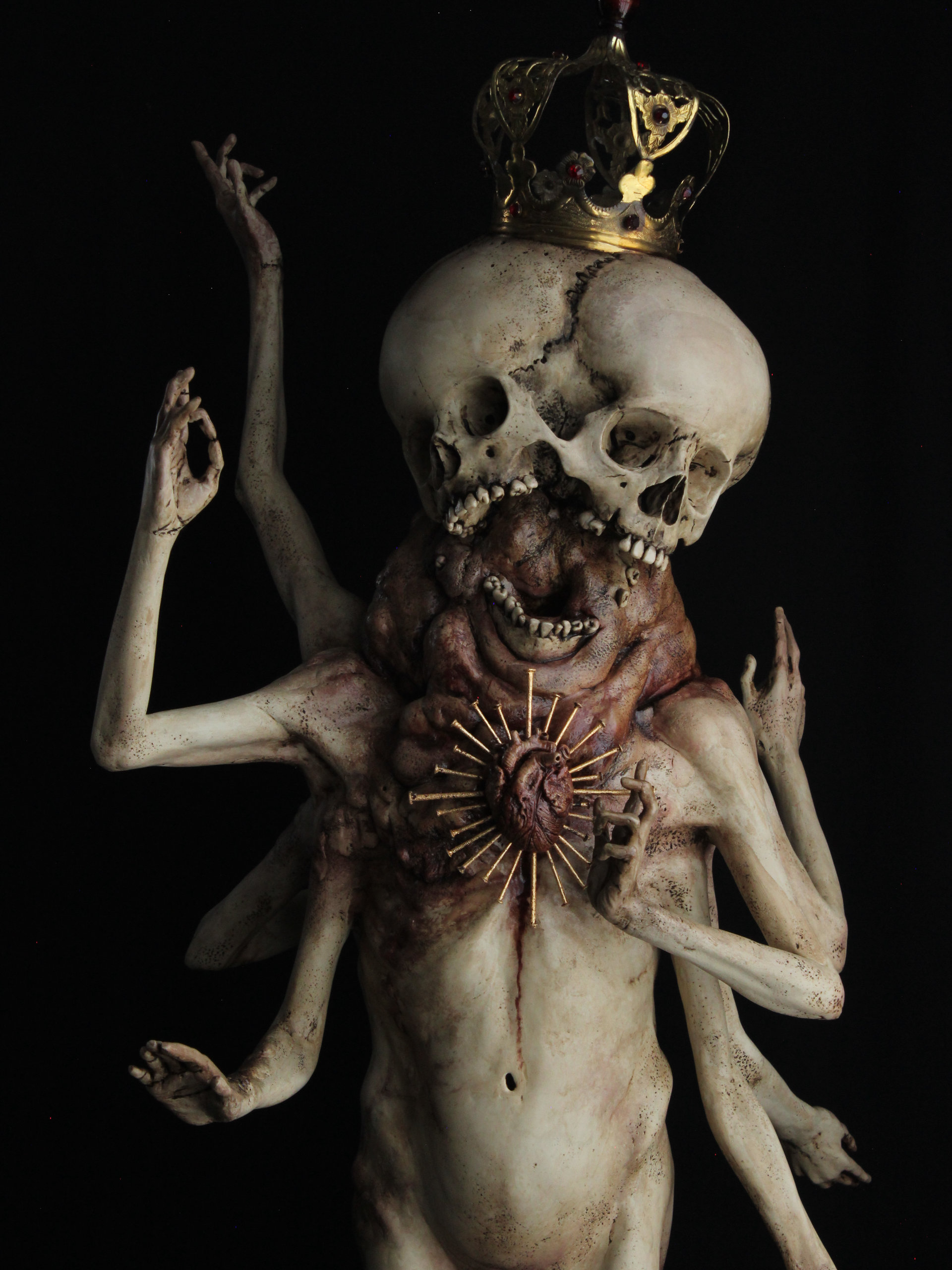
I want each of my sculptures to have a strong presence, a unique personality; and for all my artworks as a whole to give the impression of belonging to the same decadent universe.I represent this decadence in my work with the deterioration of matter and physical deformities; the grotesque. I try to represent all the imperfections of human beings through their physique, and their actions as they pass through this earthly world.In contrast, I represent the spiritual aspect with the beauty of faces and their expressions. I am inspired by sacred art because its virgins transmit suffering, but also a connection between the mundane and the divine.The beauty in my sculptures represents the search of the human being to transcend, to exalt the virtues, to go beyond the material. The suffering in the expressions represents that spiritual work can be extremely painful, to the point of agony and suffering. I like to work with the medical aspect, which denotes the scientific interest; and the sacred aspect, which denotes the spiritual interest. This mixture creates an interesting and contradictory aesthetic, like the dissection of an ethereal entity. Regardless of the themes that I approach with my different works (sometimes more focused on the medical, sometimes more focused on the religious, sometimes more surreal or fantastic), most of them speak of memento mori (“Remember that you will die”), highlighting the importance of valuing and making the most of every moment of our brief existence as human beings.
Your art explores concepts like pessimism, nihilism, and existentialism. Which philosophers or texts have most influenced your artistic perspective?
The backbone of my sculptural work is mainly based on the philosophy of memento mori, and Stoicism. In addition, my wife Fernanda came into my life to complement this philosophy with the concept of amor fati (“Love of destiny”) which invites us to accept and value everything that happens to us in life, both the good and the bad. While doing my work I like to meditate on these concepts and I try to impregnate all my work with this spirit of reflection. I like to give a nihilistic or even pessimistic character to some of my sculptures representing what I tend to see in some aspects of society, but I identify myself more as stoic in my philosophy of life.If my work evokes feelings of emptiness, I would like that to invite reflection on what is wrong with human beings and the institutions we have created, not to deny meaning to life or existence. As human beings we are capable of creating beauty, but we are also capable of horrible things from the individual to the institutional. With some of my sculptures I express this criticism of the corruption of humanity.
You’ve mentioned your Mexican heritage as an inspiration. How does Mexican art and culture, particularly its unique relationship with death, influence your aesthetic?
In Mexico, we have always had a very close relationship with death. In the pre-Hispanic period great importance was given to rituals, offerings, and even sacrifices. There has always been a cult of death, from symbolic and ritual aspects to events full of blood and suffering, but at the same time of great admiration and recognition for what they represented.Later came Catholicism where Christ is represented bloody, carrying his cross, hurt by his crown of thorns, scourged until he bleeds and dies.I have been struck by how the cult of death is manifested from our pre-Hispanic origins and later with the mixture of other religious traditions, mainly Catholicism because it is the largest religion in Latin America. Death is always impregnated with the crudest images like suffering, blood, sacrifice — but also related to the beauty of the transcendence of the spirit.My art reflects a great influence of sacred art because my culture is strongly linked to Catholicism. I like to exalt the beauty of this art and add to it a critique of the cruder aspects that it transmits to me. Everything has its positive and beautiful side and its dark side; you will also notice in my work this constant reference to duality.
Your sculptures engage heavily with the macabre. What is your process for grappling with these challenging themes, and how has creating this art affected your personal view of mortality?
Constantly working on the topic of death has made me value life and be very conscious of our limited time.My sculptural work has also served as a means of catharsis, and even as thanatological therapy by reflecting deeply on the most complex aspects of human life and accepting death as a process that will eventually happen.
What is a common misconception you’ve encountered about your work that you would like to address?
Some people assume that I have something against the Catholic or Christian religion, that some of my sculptures are satanic, blasphemous or that I make them with malicious intentions, and I would like to clarify that this is not the case.My work is usually an essay on the human psyche and our belief systems. It is true that I feel a special interest in Catholicism because it is the closest religion with which I have interacted, besides the fact that I find sacred art particularly beautiful but at the same time very macabre and tenebrous without intending to do so, and that fascinates me.
Share
You might also like ...

Dark Art – Ariel de la Vega
Your drawings are noted for their use of a white line on a black surface. What is the significance of this inversion of traditional drawing,

Dark Art – The Lijilja
Your work is deeply personal. How did this style of performance develop for you? Were there mentors who shaped it? How did your mode of

Dark Art – Sven Harambasic
In an interview, you mentioned that you prefer to deal with “isolated, inner worlds” rather than wider social commentary. How do you find and explore

Dark Art – Samuel Araya
The dark art genre sometimes exists outside of the mainstream art world. Has the intense and provocative nature of your work created any unique challenges