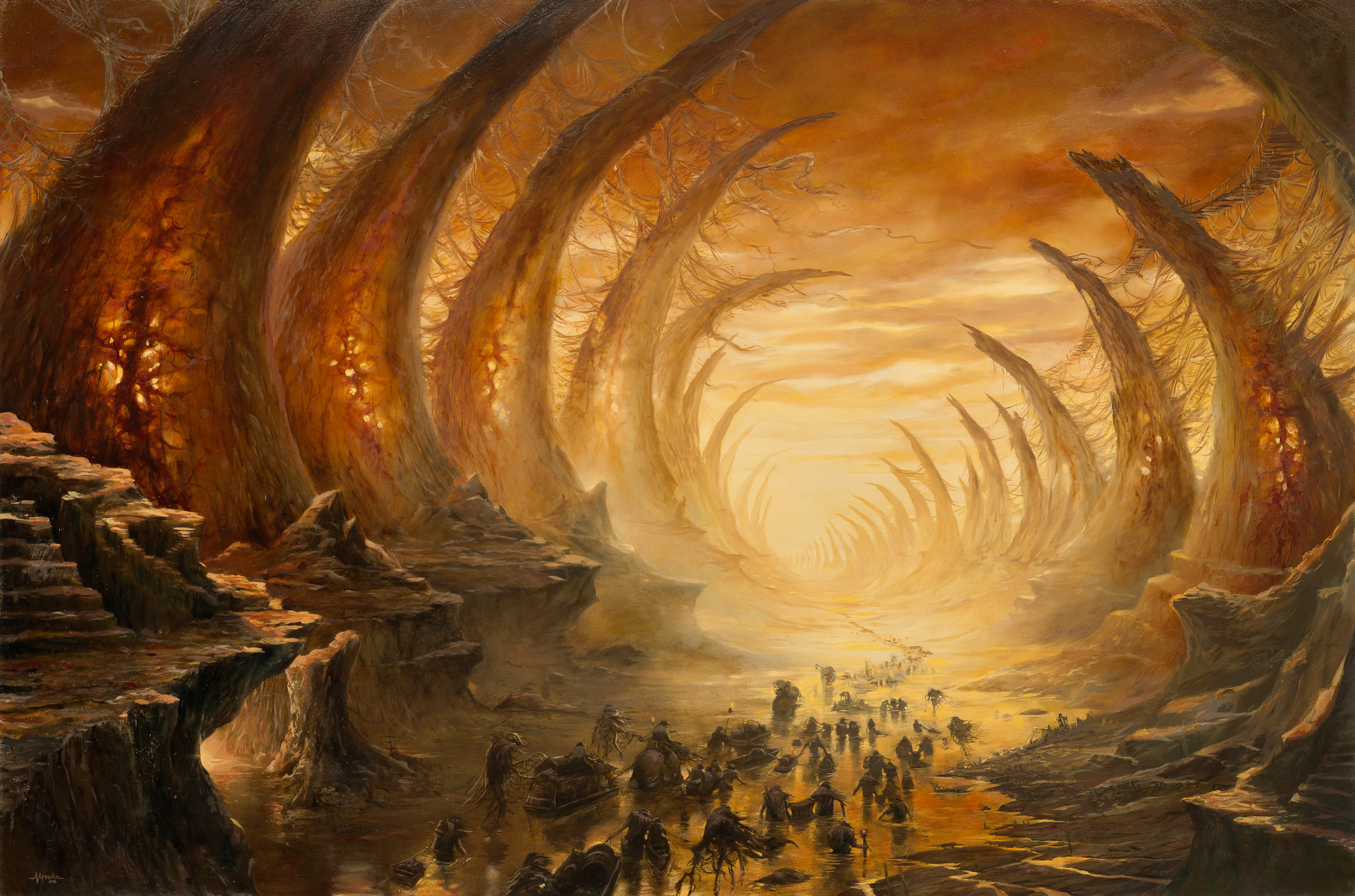
Your paintings often feature creatures and characters as “abandoned inhabitants.” What is the story you are trying to tell by placing these figures in such vast, solitary settings?
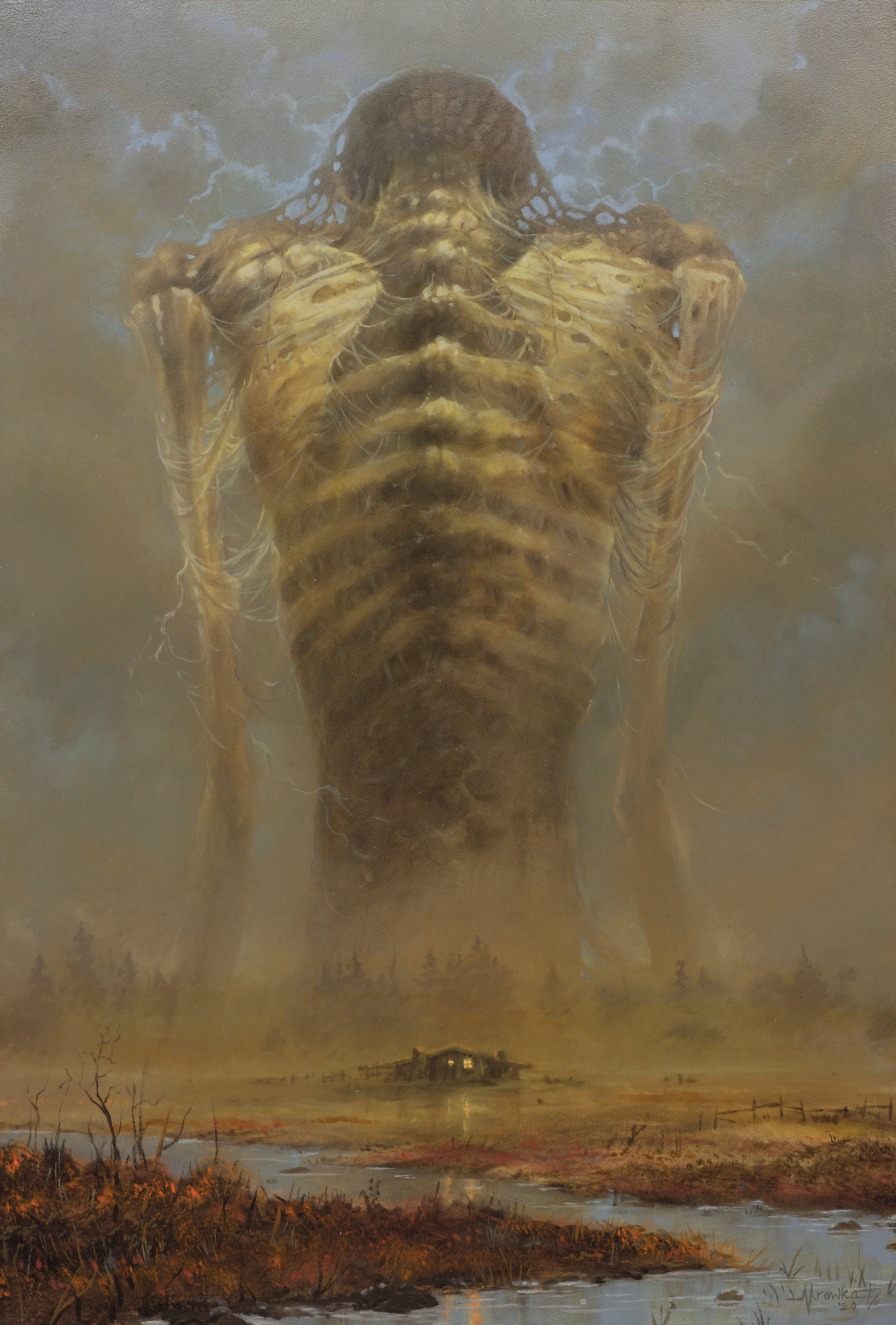
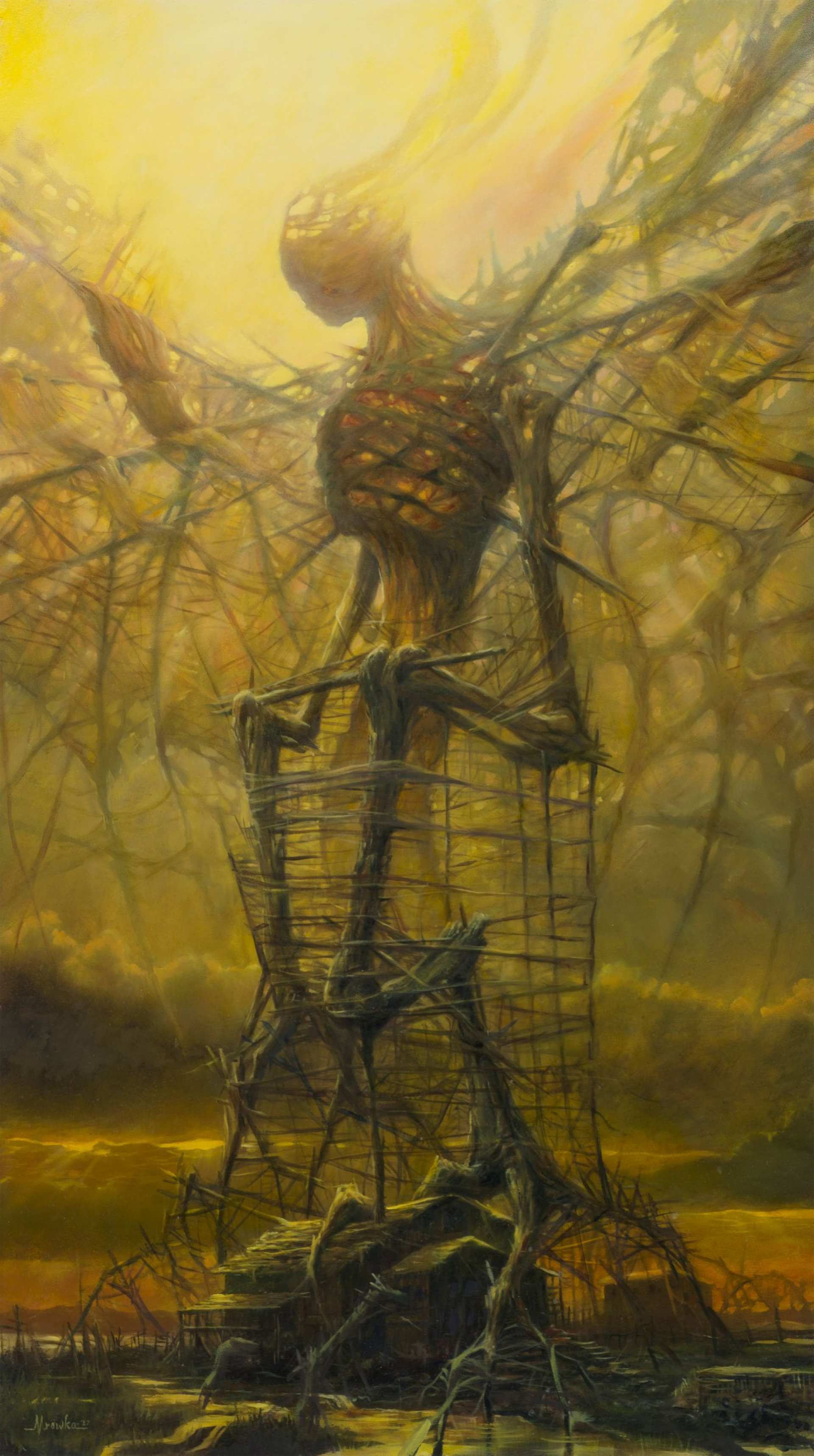
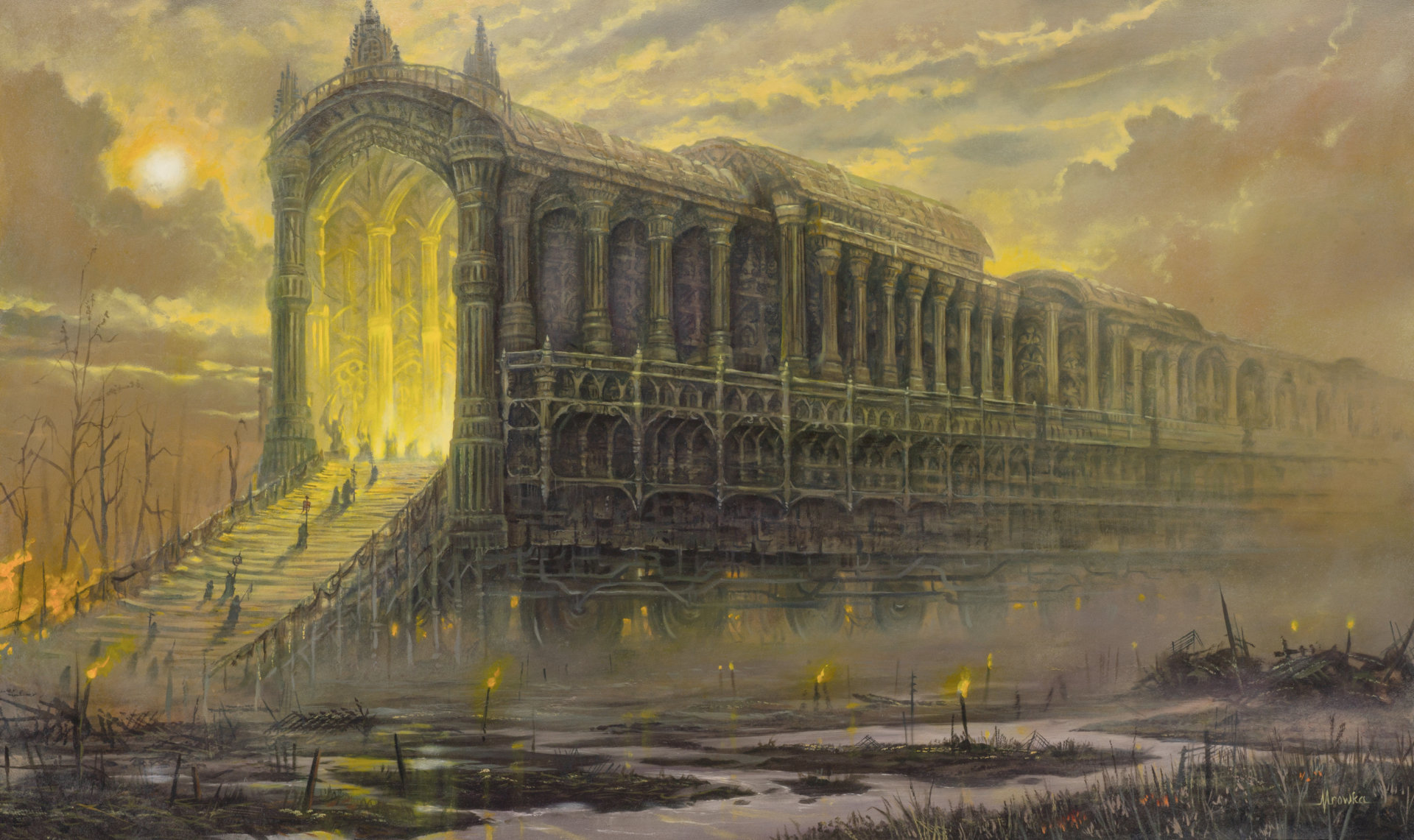
When I place wanderers in these vast and perpetually liminal worlds they represent residual consciousness. The story is long over. Any environments or set pieces familiar to us are no longer familiar to these nomads. The ghosts linger and seek. They explore. They probe. They represent the last vestiges of the sentient desire to experience and exist. In the paintings they exist to observe and give the viewer a sense of scale and perspective, but as characters I see them as antennae.
You’ve stated that you keep the “meanings” of your illustrations a mystery for viewers to speculate. What is your philosophy on the artist’s role in guiding or withholding narrative, and how do you feel about the interpretations people create?
I see my role as an observer, and my work as a catalyst for questioning. I have no answers, I’m vehemently agnostic. The only thing I know for certain is that I know absolutely nothing for certain. My work is about tapping into a feeling, going to a place. I want you to feel abandoned but safe. I want to spark curiosity and the desire to explore difficult concepts like existential dread, depression, solitude, entropy, and decay. These are all things that loom in me and consume far too much of my thought so they leek into the work. Since I’m searching for a feeling most importantly, the environmental story telling serves as a means to that end. Also, if anyone wants to dig further into the paintings’ meanings, the titles are always a bit of a riddle and clue. I think carefully about the titles.
In a world where much of fantasy art relies on established mythologies, how do you find inspiration to create entirely new environments and beings from scratch?
I actually find it much easier to invent than to iterate. When there are no established guidelines, there are no rules. Artists tend to think best while working so a lot of the images are created in an automatic way.
I usually have a loose daydream image or feeling I want to convey going into a piece, but if the painting wants to take a different path, I tend to oblige. I’ve found that if I let the process happen more like a channeling, then the work feels more honest and cathartic. Dark art can swing into the realm of “corny” or “cringe” very easily if it’s not completely honest.

What was the initial spark of inspiration for the painting Admission? Could you walk us through the creative journey of bringing this piece to life?
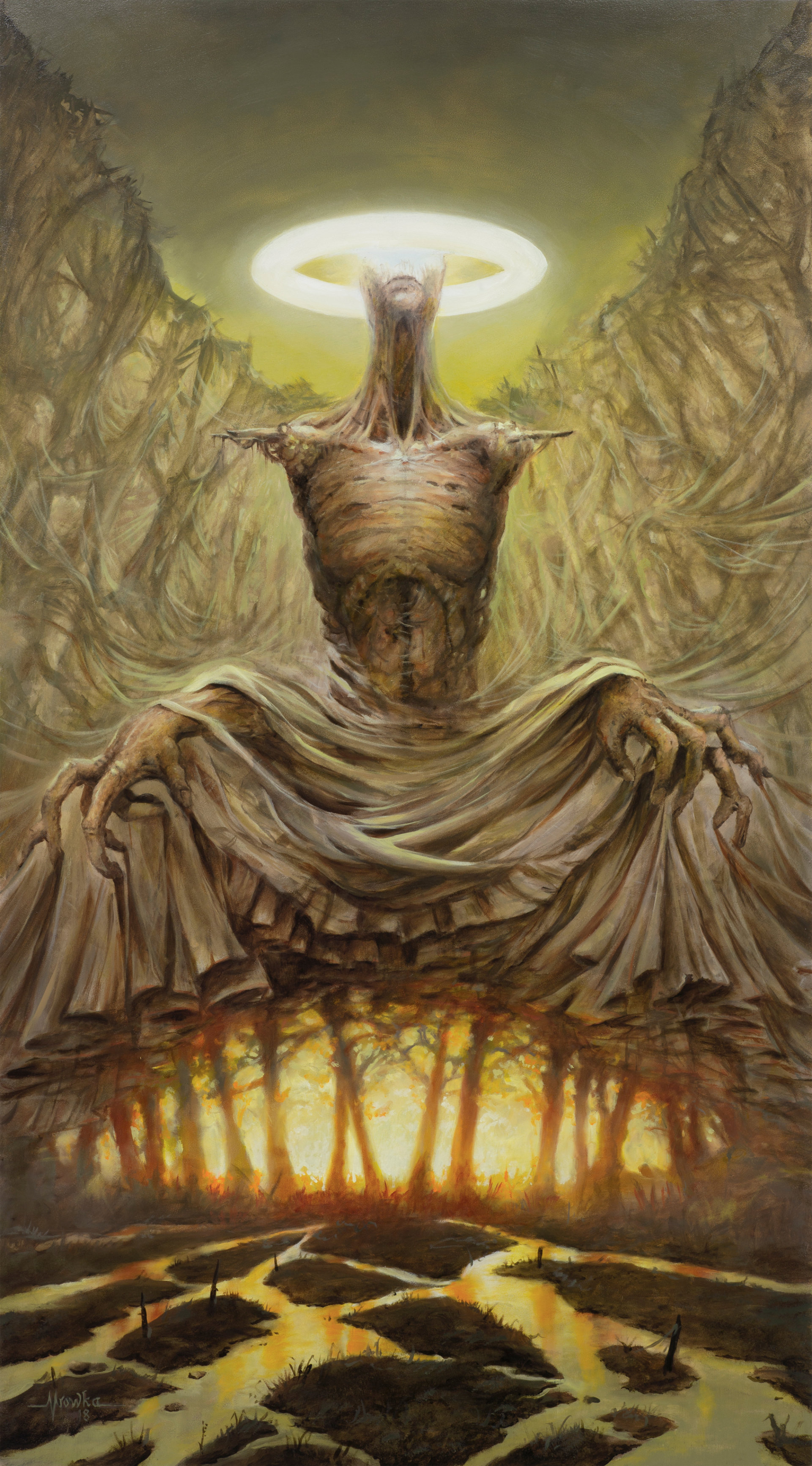
Admission was made specifically for a show called “Roadside Attractions,” curated by the mighty Cris Velasco. I’m enamored by the American dust bowl era and all things Carnivale. This painting gets mired, probably convoluted in its levels of meaning but I really liked the idea of a side show “ringmaster” (godlike character) lifting a curtain or veil to reveal something sublime rather than conventionally hideous. The peak of the glow of the backlit forest interior was one of those automatic things that happened. I had no idea what was going to be there until it showed up but it’s a nice moment to fall into. The ringmaster started out a more sculptural form early on but became much more non-corporeal when the foreground developed. Another one of those things the painting decided to do without me ever knowing why.
What is a common misconception you’ve encountered about your work that you would like to address?
I’ll take any misconceptions or conceptions, if folks are reacting. I think my work is often seen as more hopeless than I intend. To me, these paintings are very comforting places to explore. They’re quiet, warm, expansive. I feel most at peace in these places, possibly because they illustrate so honestly how derelict we all really are in the universe. That’s not a negative thing to me. My work is never lamenting. A painter needs to be comfortable with spending many many hours alone in a studio, and I’m more comfortable with that than most. These paintings dog-whistle a type of peace and hope that many will never feel. I experienced this emotional reaction when I saw my first Beksiński painting, and the influence has clearly never left.
What upcoming projects or exhibitions are you currently working on?
I’m currently working on putting together work to be shown at the 18th annual IX ART SHOW 2025 (Illuxcon in Reading Pennsylvania October 22nd through the 26th) where my wife Michelle and I will have some very special and rare collaborative pieces as well as individual works from the past year. I’m a twenty year full time tattooer at Dark Space Art Collective in Troy, NY booking appointments for late 2025/early 2026. Keep an eye out for new prints and paints this year as well as a deep secret musical project in the works.

Dark Art – Ariel de la Vega
Your drawings are noted for their use of a white line on a black surface. What is the significance of this inversion of traditional drawing,

Dark Art – The Lijilja
Your work is deeply personal. How did this style of performance develop for you? Were there mentors who shaped it? How did your mode of

Dark Art – Sven Harambasic
In an interview, you mentioned that you prefer to deal with “isolated, inner worlds” rather than wider social commentary. How do you find and explore

Dark Art – Samuel Araya
The dark art genre sometimes exists outside of the mainstream art world. Has the intense and provocative nature of your work created any unique challenges